
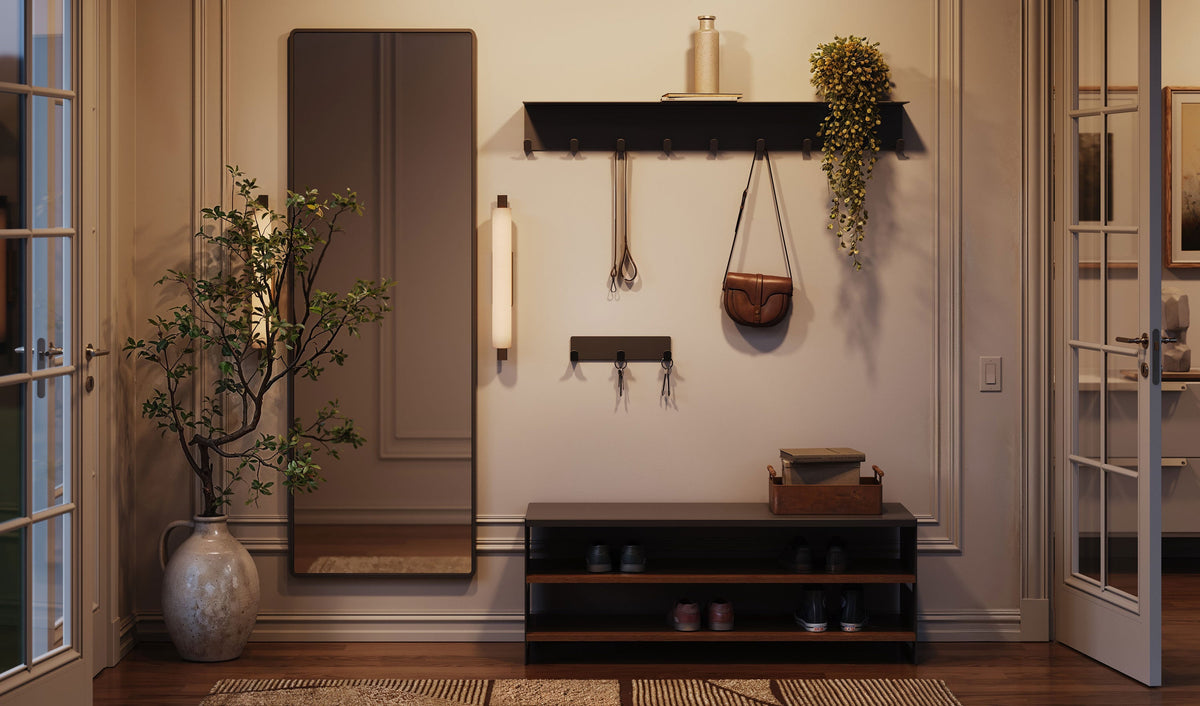
The key to furnishing a small living room or entryway is wall storage: floating shelves, coat hooks and shoe racks free up floorspace for slim tables sized to fit.
The real challenge in a small room is floorspace. The sofa edges into the walkway, the front door swings into a pile of coats, and shoes collect wherever they come off. None of that means the room can’t be stylish and easy to live in. The answer is to put your walls to work: move storage up off the floor, and choose furniture sized to the space that’s left. Here’s how.
The best small living room furniture ideas are often the simplest. Each piece we recommend comes with real measurements, so you can check it against your sofa, your walkway and the swing of your front door before anything arrives.

Jump to a topic:
Floorspace Is Precious. Put Your Walls to Work.
In a small living room or entryway, put storage on the wall and keep anything on the floor slim, lifted on legs, or sized to the exact gap it fills. Every piece you move off the floor gives back walking room, and in a small space, walking room is usually the first thing to go.
Before anything comes home, run it past three simple questions:
- Could it go on the wall? Books, keys, coats, plants and even shoes can all live up off the floor, which leaves the space below open for walking and easy to clean.
- If it stays on the floor, can you see floor under or through it? Furniture on legs and racks with open shelves let your eye travel all the way to the baseboard, so the floor reads as one continuous surface. A solid cabinet with the same footprint stops the eye at its edges and feels bulkier than it is.
- Have you measured the spot it’s going? Measure the real space, from sofa arm to wall or from door swing to corner, and shop to that number rather than to a “compact” label.
A couple of classic moves still help, too: a mirror near a window carries daylight deeper into the room, and lighter walls keep a compact space feeling open.
Small Living Room Furniture Ideas
Start with the wall, then choose a coffee table that keeps the walkway clear and a side table that fits the space beside the sofa. Working in that order means that once the shelves are up, you know exactly how much floor is left for the rest of your small living room furniture.
Swap the Bookcase or Console for Floating Shelves
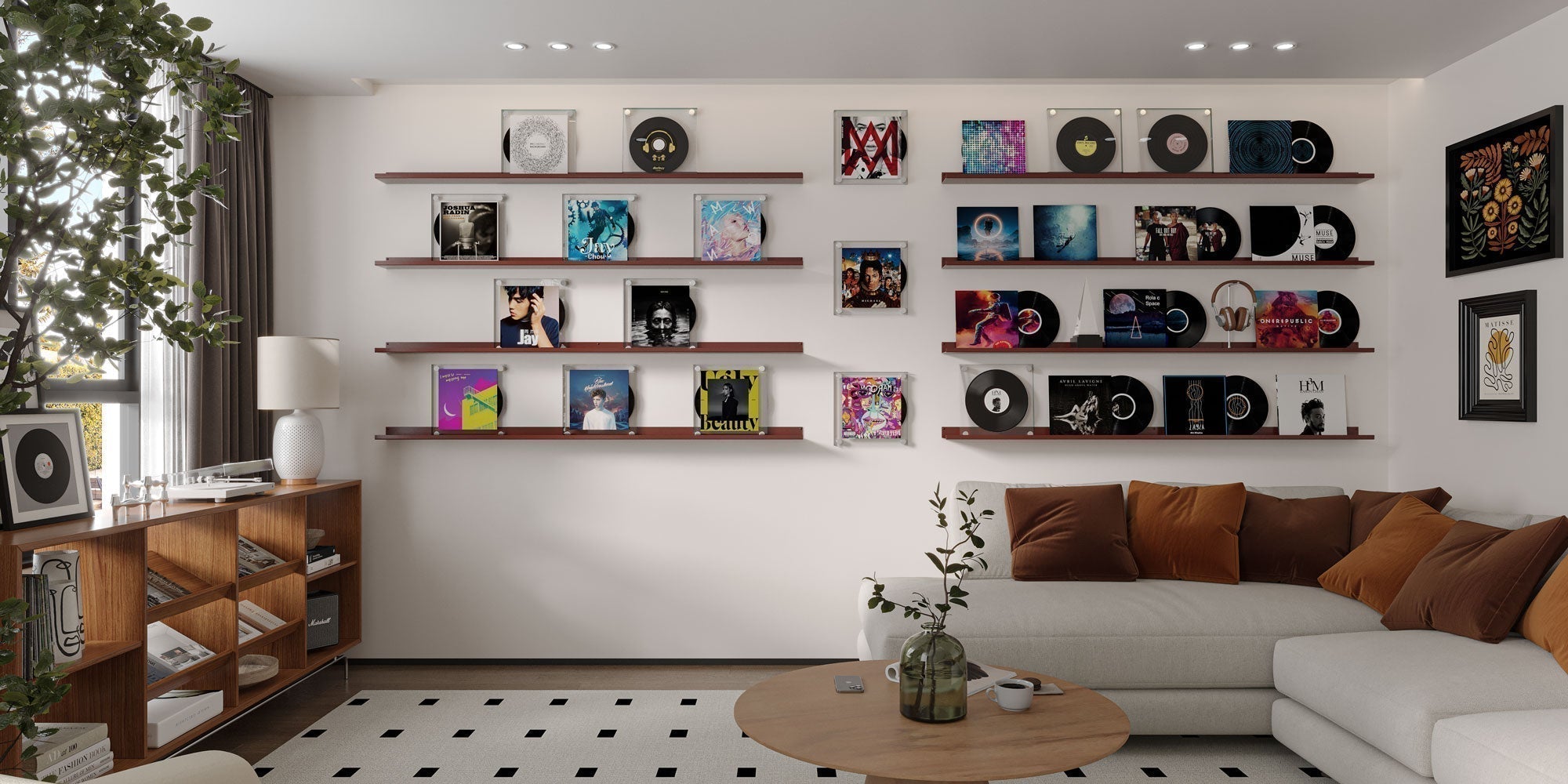
Floating shelves hold everything a bookcase or console would without taking up any floor. A bookcase claims a strip of floor along the whole wall it stands against, while shelves above the sofa use space that was sitting empty anyway.
Our floating shelves come from 6″ to 84″ long and 4″ to 12″ deep. In our metal floating shelves, solid steel lets a slim shelf carry a lot: the Tromso Steel Floating Shelf holds about 410 lbs per linear foot at 4″ deep and about 90 lbs per linear foot at 12″ deep. Shallower shelves hold more because weight sitting closer to the wall puts less leverage on the mounting point, so a 6″ or 8″ shelf above the sofa handles paperbacks, frames and a trailing plant with room to spare. If you’d rather see wood grain than steel, wood floating shelves work just as well in the same spot.

Hang the lowest shelf about 8″ to 12″ above the back of the sofa. One to three shelves is plenty in a small room, and if you stack them, about 10″ to 12″ between shelves leaves room for books to stand upright and slide out easily.
The one tradeoff is installation, since every Shelfology floating shelf mounts into studs rather than drywall alone. If you rent, check your lease first and plan to patch a few screw holes when you move out.
Choose a Coffee Table That Keeps the Path Clear
In a tight room, a round coffee table takes the corners out of the walkway, and a lower shelf adds storage without adding another piece of furniture. Leave about 14″ to 18″ between the table and the sofa, which keeps your coffee within reach and still leaves room to walk past.
Round matters most where the path between the sofa and the TV is narrow. A square corner sticks out into that path, while a curved edge falls away from it and lets people pass on either side.
- The Otis Round Coffee Table is a light, open take on the round coffee table, with two thin tiers of steel resting on solid wood legs. The top and open lower shelf are powder-coated 11-gauge steel and the legs are solid Walnut or White Oak, so the steel keeps the profile slim, the shelf gives books and remotes a place to land, and the wood adds warmth while leaving the floor visible straight through the base. Choose a 30″, 36″ or 42″ diameter, with the steel in any of six colors.
- The Ledger Coffee Table is a round slab of solid hardwood, a full 1¾″ thick, on a slim steel base. It flips the Otis formula: the top is solid Walnut or White Oak, and the powder-coated steel base carries its own lower shelf. Ledger comes in the same 30″, 36″ and 42″ diameters.
- If your seating group is a little larger, the Hugo Square Coffee Table has the same light build as Otis in a square, sized for a sofa and a pair of chairs. Its steel top and lower shelf sit on solid Walnut or White Oak legs, and the square shape suits a more structured arrangement where the table sits at the center of the group. Hugo comes in 30″, 36″ and 42″ sizes.
In the smallest rooms, start with a 30″ coffee table. Measure the open floor in front of the sofa, take away that 14″ to 18″ gap, and make sure a comfortable walkway is left on the far side before you size up.
Pick a Side Table That Fits the Gap
Measure the space between the sofa arm and the wall or chair next to it. A slim pedestal or a side table that slides in close to the sofa will fit where a standard end table won’t.
- The Spot On Side Table is a round top on a single slender pedestal, made for the narrow gap beside a chair or sofa. The top is solid Walnut or White Oak and the pedestal is 11-gauge steel, so all that meets the floor is one slim column and its base. It comes in two sizes, 15″ high by 16″ wide or 22″ high by 20″ wide, and the right one is whichever sits closest to the height of the seat or arm beside it.
- The Linger Side Table is a slim side table in solid wood that tucks in closer to the sofa than a standard end table can. Thick 1½″ solid Walnut or White Oak forms both the top and the back panel, a single powder-coated steel leg supports the front, and the front edge is rounded to soften the corner you walk past every day, keeping coffee, a book and the remote within easy reach.
Floating Shelves Around the TV
Floating shelves beside or below the TV can stand in for a deep media console and free up the floor in front of it. In a small living room, the console is often one of the deepest pieces after the sofa, so moving its job onto the wall gives you real walking space back.
Keep the shelves near the TV on the shallow side, around 4″ to 8″, so they hold a streaming box, a speaker or a short stack of books without crowding the screen; shallow steel shelves also carry the most weight per foot. Sticking with one finish across the whole wall makes the TV, shelves and hardware look like a single, planned arrangement.
Small Entryway Ideas
A small entryway needs three things: a hook for every coat and bag, a flat spot for keys and mail, and a place for shoes that isn’t the floor. The same thinking matters even more by the door, where the floor has to stay clear enough to walk through with your arms full.
Think of it as a tiny mudroom built on a few feet of wall: with the right small entryway storage, it becomes a drop zone that catches everything at the door before it ends up in the rest of your home. A runner or a 2′ × 3′ rug marks where the entry begins, and a mirror by the door gives you a last look on the way out while bouncing light into what’s often a dim corner.
The Morgan Magnetic Pegboard gives the small things by the door, like mail, keys and sunglasses, a spot of their own. A solid birch face sits over a powder-coated 14-gauge steel backer, and accessories with built-in magnets snap into place, so the layout can change whenever your routine does. It comes in 24″ × 24″ or 24″ × 48″, in the same six colors as the rest of the line.

A Shelf and Coat Hooks in One Piece
A shelf with built-in hooks handles coats and the mail pile in one piece, so there’s only one set of studs to find.
The Tromso Steel Floating Shelf + Coat Rack is a shelf above and hooks below, in one clean line of solid steel. Keys and mail go on the ¼″ steel shelf while jackets and bags hang beneath it. It’s cut to any length from 12″ to 60″ and comes 4″ to 12″ deep, and it gains hooks as it gets longer, from 3 on a 12″ to 20″ shelf up to 7 on a 51″ to 60″ shelf. It holds up to 90 lbs per linear foot and comes in 30+ powder-coat colors. Since coats, bags and everything on the shelf all pull on the same mounting line, it installs into studs or solid blocking rather than drywall alone.
The Splendid Shelf + Coat Hooks is a slimmer take on the same idea: a narrow steel shelf set over a rail of hooks, with a hidden cover that keeps the mounting out of sight. Choose 3, 5, 7 or 9 hooks in any of the six powder-coat colors, so it can match a coffee table or shoe rack across the room.

If you only need somewhere for coats, wall hooks take up less wall and less planning. The Of Course Wall Hook lines up 3, 5, 7 or 9 steel hooks along one clean rail, its mounting hidden behind a covered front. For a single hook, the all-steel Popsicle Wall Hook holds 50 lbs and the Doohooky Wall Hook holds 150 lbs, and each one mounts into a stud or a properly rated drywall or masonry anchor.

For kids, Kiddo Hooks come in six animal shapes (a cat, dragon, giraffe, hippo, monkey and unicorn), all made from 11-gauge steel. Hang them low enough for small hands to reach, and backpacks and jackets have a home kids can manage on their own.
As a rule of thumb, plan on one hook per person in the household, plus one for guests.
Corner Shelves for a Narrow Entry
In a narrow entry, the corner is free storage, and a corner shelf holds keys, a plant or the mail well clear of the door’s swing.
The Wink Corner Floating Shelf is a small steel triangle that turns an empty corner into a spot for keys or a plant. It’s made from 11-gauge steel in 8″, 10″ or 12″ sizes, and every size holds 80 lbs. Choose a triangle or rounded front, add an optional hole for a lamp or charger cord, and pick from 30+ colors. It mounts into studs or with the included drywall or masonry anchors, and if a triangle isn’t your shape, browse our other corner floating shelves.
Four Ways to Store Shoes in a Small Entryway
The right small entryway storage for shoes depends on the space you have: a bench with shoe shelves if there’s room to sit, a wall-mounted rack if there’s no floor to spare, a freestanding rack if you can’t drill, and a low rack kids can reach on their own.
| If your entry has… | Choose | What to know |
|---|---|---|
| Room to sit | Take Five Bench + Shoe Rack | 36″ or 48″ long with an 18″ seat height; steel frame in six colors; two solid Walnut or White Oak shoe shelves |
| No floor to spare | Chuck It Up Shoe Rack | Wall-mounted; 24″, 36″ or 48″ long; two steel shelves, 12″ deep, for larger shoes; hidden hardware; drywall or masonry anchors included |
| No drilling allowed | Kicker Shoe Rack | Freestanding; 24″, 36″ or 48″ long; two angled steel shelves on solid Walnut or White Oak legs; slots let grit fall through |
| Kids | Kiddie Kicks Shoe Rack | Freestanding; 24″ or 36″ long; one steel shelf at kid height on solid White Oak legs; wave-shaped front edge |
- With the Take Five Bench + Shoe Rack, you sit, slip off your shoes, and put them away in one easy motion. A powder-coated steel frame holds an 18″-high seat above two solid Walnut or White Oak shelves, so even a small entry gets a place to sit and a place for shoes in a single footprint.
- When the floor is already spoken for, the Chuck It Up Shoe Rack is two slim steel shelves that give every pair a home on the wall instead of underfoot. Both are 11-gauge steel, 12″ deep with 8″ between them, roomy enough for sneakers and larger shoes, and magnetic cover plates hide the mounting hardware. With nothing touching the floor, you can sweep or vacuum right underneath, a real plus in the spot that collects the most grit.
- The Kicker Shoe Rack is a freestanding rack with shelves angled toward you, so every pair is easy to see and grab. Because it needs no holes in the wall, it’s a natural fit for renters, and slots along each steel shelf let dirt and gravel fall through instead of collecting under your shoes. Being freestanding, it can move wherever the pile tends to land, with the tradeoff that it uses floor a wall rack would leave open.
- The Kiddie Kicks Shoe Rack is one low shelf with a wave-cut edge, set low enough for small hands. Its powder-coated steel shelf sits on White Oak legs, which makes putting shoes away something kids can do without help.

When the Front Door Opens Into the Living Room
Build the entryway on the wall beside the door. Hang hooks or a shelf with hooks for coats and keys, stop shoes right at the door with a wall-mounted or low rack, and mark where the entry ends with a runner rug or a slim bookshelf against the wall.
Plenty of apartments and older homes have no foyer at all, so you build the entry from the wall you already have. Here’s how, in four steps:
- Claim the wall nearest the door. A Tromso Steel Floating Shelf + Coat Rack gives coats, bags and keys a single home within arm’s reach of the handle, or a row of wall hooks covers lighter needs.
- Stop shoes at the door. The Chuck It Up Shoe Rack keeps them off the floor when space is tight, and the Kicker Shoe Rack does the same job with no drilling. Either way, shoes stay at the threshold instead of ending up in the living room.
- Mark where the entry ends. A runner rug draws the line on the floor, or you can draw it with storage. The Halle Bookshelf is a narrow bookshelf, just 8″ deep, that marks the edge of an entry without closing it off; stand it against the wall where the entry meets the living room. It pairs solid Walnut or White Oak shelves with a powder-coated steel frame in 3, 5 or 7 shelves (30.75″, 56.75″ or 82.75″ tall). Anchor the taller versions to the wall.
- Use one finish for both zones. When the coat rack, shoe rack and living room shelves share a wood and a color, the entry looks like part of the room rather than a separate project added later.

Make Two Small Rooms Feel Like One
When the entry and living room share space, repeat one wood and one color across both.
Shelfology furniture and shelving share the same solid Walnut and White Oak and the same six powder-coat colors: White Matte, Black Matte, Army Brat (an olive green), Steely Blue (a muted mid blue), Honey Mustard (a warm golden yellow) and Claymore (a warm medium coral). Picture an Otis Round Coffee Table with Walnut legs and Steely Blue steel in the living room and a Kicker Shoe Rack in the same Walnut and Steely Blue by the door, and the two zones come together without any hunting for a match. Metal shelves and hooks also come in a range of 30+ colors, and any RAL color can be matched on request. Every piece here is designed and built in the US, and when you call with a question, a real person picks up.
Small-Space Furniture at a Glance
Use this quick reference to compare sizes, mounting and the room each piece suits.
| Piece | Type | Size | Mounting | Room |
|---|---|---|---|---|
| Spot On Side Table | Side table | 15″H × 16″W or 22″H × 20″W | Freestanding | Living room |
| Otis Round Coffee Table | Round coffee table | 30″, 36″ or 42″ diameter | Freestanding | Living room |
| Ledger Coffee Table | Round coffee table | 30″, 36″ or 42″ diameter | Freestanding | Living room |
| Hugo Square Coffee Table | Square coffee table | 30″, 36″ or 42″ | Freestanding | Living room |
| Tromso Steel Floating Shelf | Floating shelf | 6″–84″ long, 4″–12″ deep | Studs | Both |
| Tromso Steel Floating Shelf + Coat Rack | Shelf with hooks | 12″–60″ long, 4″–12″ deep | Studs or blocking | Entryway |
| Splendid Shelf + Coat Hooks | Shelf with hooks | 3, 5, 7 or 9 hooks | Wall | Entryway |
| Of Course Wall Hook | Hook rail | 3, 5, 7 or 9 hooks | Wall | Entryway |
| Morgan Magnetic Pegboard | Pegboard | 24″ × 24″ or 24″ × 48″ | Wall | Entryway |
| Wink Corner Floating Shelf | Corner shelf | 8″, 10″ or 12″ | Studs or anchors | Both |
| Halle Bookshelf | Bookshelf | 30.75″, 56.75″ or 82.75″ tall, 8″ deep | Against the wall; anchor taller units | Both |
| Take Five Bench + Shoe Rack | Bench + shoe rack | 36″ or 48″ long | Freestanding | Entryway |
| Chuck It Up Shoe Rack | Shoe rack | 24″, 36″ or 48″ long | Wall, anchors included | Entryway |
| Kicker Shoe Rack | Shoe rack | 24″, 36″ or 48″ long | Freestanding | Entryway |
| Kiddie Kicks Shoe Rack | Kids’ shoe rack | 24″ or 36″ long | Freestanding | Entryway |
Small Living Room and Entryway FAQ
How do I furnish a small living room without it feeling cramped?
Put storage on the walls and keep the floor open. That means floating shelves instead of a bookcase or console, a round coffee table or one with a lower shelf, and a side table sized to the gap beside the sofa. Keep anything that stays on the floor raised on legs, so you can see the floor underneath.
What furniture do you need for a small living room?
Most small living rooms need seating, a coffee table, at least one side table, some shelving and good lighting. In a small room, wall-mounted floating shelves can serve as the storage piece, which takes the bookcase or console out of the floor plan and leaves more room for the sofa and the walkway.
How far should a coffee table be from the sofa?
About 14 to 18 inches is the general guideline, close enough to reach a drink or a book from the sofa and open enough to walk between the two. In a very tight room, stay toward the low end of that range and choose a smaller table rather than squeezing the gap.
Is a round or square coffee table better for a small living room?
Round usually works better in a tight, high-traffic room because it takes corners out of the walkway and lets people pass on any side; the Otis Round Coffee Table and Ledger Coffee Table are both round. Square suits a larger, more structured seating group, where the Hugo Square Coffee Table anchors the middle.
What’s the best shoe storage for a small entryway?
It depends on your space. The Take Five Bench + Shoe Rack works when there’s room to sit, and the wall-mounted Chuck It Up Shoe Rack suits entries with no floor to spare. The freestanding Kicker Shoe Rack works when you can’t drill, and the Kiddie Kicks Shoe Rack gives kids a low shelf of their own.
What can I do if my front door opens into the living room?
Build a drop zone on the wall beside the door. Hang hooks or a shelf with hooks for coats and keys, keep shoe storage right at the door, and mark where the entry ends with a runner rug or a slim bookshelf against the wall. Repeating one wood and one color across both zones makes them read as one room.
Do floating shelves need to go into studs?
Shelfology floating shelves and the Tromso Steel Floating Shelf + Coat Rack install into studs or solid blocking, not drywall alone. Lighter wall pieces offer more flexibility: wall hooks and the Wink Corner Floating Shelf can use properly rated anchors, and the Chuck It Up Shoe Rack comes with drywall or masonry anchors.
Start With Two Walls
Start with the wall nearest the sofa and the wall nearest the door, since that’s where a small home gets the most floor space back. Shop our small living room furniture for floating shelves, coffee tables and side tables, and our small entryway storage for coat racks, hooks and shoe racks, all in matching woods and colors.
Share:
9 Tips for Planning Your Floating Shelf Project