
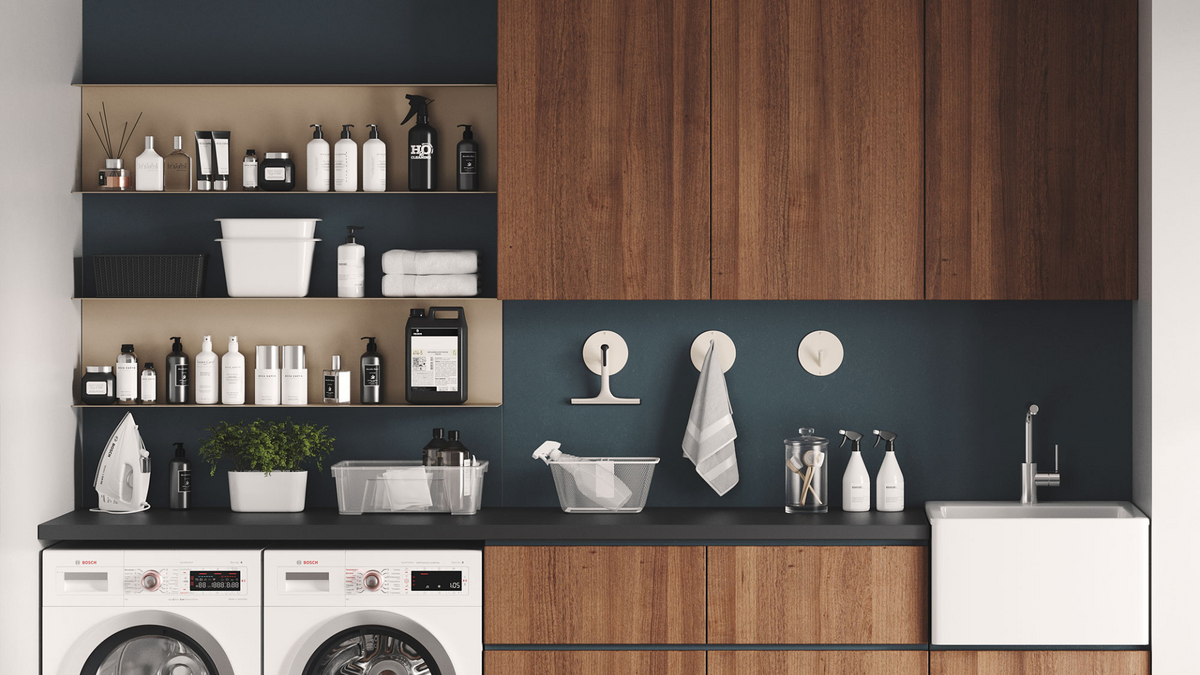
How high to hang a shelf over a washer and dryer, how deep and long to make it, how much weight it holds, and why it mounts into studs.
TL;DR: For a shelf over a washer and dryer, hang the bottom edge about 18″ above a front-loading pair or about 24″ above a top-loader, after opening the top-loader’s lid all the way to check its clearance. Make the shelf just deep enough for the largest bottle you’ll keep on it and long enough to span both machines, then mount it into studs, since a loaded shelf pulls on its top screws like a lever.
Every load of laundry starts and ends at your machines, yet the wall above them usually sits empty while the stain spray balances on the dryer lid and the dryer sheets slip into the gap between the machines. A single well-planned shelf puts all of it in order. Getting that shelf right comes down to four factors—how high, how deep, how long and how much weight—and each one depends on your machines, so start with a tape measure.

Jump to a topic:
- Shelf Height Above a Washer and Dryer
- Laundry Room Shelf Depth
- Shelf Length Over a Washer and Dryer
- How Much Weight a Shelf Over the Washer Can Hold
- Floating, Bracket or All-Steel Shelves Over the Washer
- Laundry Room Shelves and Studs
- Shelves for Stacked Washers and Laundry Closets
- What to Put on the Shelf Above the Washer
- FAQ
- Planning the Whole Laundry Room Wall
Shelf Height Above a Washer and Dryer: Measure the Machines First
Over a front-loading washer and dryer, the bottom of your shelf usually sits about 18″ above the machine tops—close enough to reach without stretching, and high enough to leave room for folding on top of the dryer.
Top-loaders play by a different guideline, about 24″ above the machine, because the open lid sets the limit. Open the lid all the way, measure from the floor to its highest point and add a few inches so your hand and a detergent scoop fit comfortably between lid and shelf; that’s the lowest your shelf can go.
Both figures are general design guidelines rather than Shelfology specifications, much like the 18″ countertop-to-shelf standard in our kitchen shelf height guide. Before you mark the wall, run two quick checks:
- Hang it for the shortest person who does the laundry, so a full jug never has to come down from overhead.
- Keep the water shutoff valves within reach, since a shelf that boxes them in turns a small leak into a scramble.
Laundry Room Shelf Depth: One Row of Bottles or a Row of Bins
Go too deep and half-used bottles vanish into the back row; go too shallow and the basket you bought for the shelf won’t fit on it. Shelfology’s shelves for over the washer run from 4″ to 14″ deep, so the choice comes down to what you’ll keep there: a deeper shelf makes room for bins, baskets and stacks of folded towels, while a shallower one keeps every bottle in a single row, in plain sight.
Shallow shelves are also the stronger ones—each added inch of depth moves the load farther from the wall and increases the leverage on the mounting. Tromso proves it: the same ¼″ steel is rated to 410 lbs per linear foot at 4″ deep, 170 lbs at 10″ and 90 lbs at 12″, and the only thing that changes is how far the weight sits from the wall.
To settle on a number, measure the deepest container you plan to keep up there, add an inch and order that depth.

Shelf Length Over a Washer and Dryer: One Long Run Across Both
Over a pair of machines, length is what separates a wall that looks planned from one that looks pieced together. Most full-size washers and dryers are about 27″ wide, so a side-by-side pair covers roughly 54″ of wall before you count the gap between them. Measure your own machines and the wall around them: a shelf that runs a few inches past each side looks intentional, while one that stops partway across the dryer looks like a measuring mistake.
Tromso shelves run 6″ to 84″ long and Roderick shelves 12″ to 84″, while the Aksel solid hardwood floating shelf is made to measure up to 118″, long enough to run wall to wall in many laundry alcoves.
In most laundry rooms, one long shelf wins—a single continuous surface that reads as built in when the bracket is hidden. Two shorter shelves make more sense when a window, a cabinet or a vent breaks up the wall.
How Much Weight a Shelf Over the Washer Can Hold: The Jugs Add Up
Laundry supplies are heavier than they look. A gallon of water weighs about 8.3 lbs, and a gallon jug of liquid detergent weighs at least as much, so two jugs, a bottle of softener and a basket of towels add up fast. Here’s what each shelf line is rated to carry when it’s mounted into studs:
- Aksel: Each hidden steel rod is rated to 50, 65, 80 or 95 lbs, depending on the bracket series (LD, MD, HD or XD), and longer shelves get more rods, so a 60″ Aksel HD with four rods is rated to 320 lbs in total.
- Roderick: Each bracket is rated to 55 lbs, and shelves up to 48″ come with two brackets while longer ones get three, which puts a 60″ Roderick at 165 lbs.
- Tromso: Capacity is rated per linear foot according to depth, from 410 lbs at 4″ deep down to 90 lbs at 12″, with an 8″-deep shelf rated to 250 lbs per foot.
- Bender: The slim steel Bender wall shelf holds 7.5 lbs per linear foot, which suits dryer sheets and stain sticks rather than jugs.
One habit takes strain off any of them: set the heaviest jugs at the back, close to the wall, where they put less leverage on the mounting—the same reason a shallow shelf is stronger than a deep one.
Floating, Bracket or All-Steel Shelves Over the Washer: Pick the Look, Then the Load
Each of our over-the-washer shelves spans a full pair of machines, and which one belongs in your laundry room depends on the look you love and the load you plan to put on it.
For a laundry room that looks built in, choose the Aksel floating shelf. It keeps its hardware to itself: the steel bracket slides inside the solid hardwood, so nothing shows beneath the shelf—just a clean board of White Oak or Walnut running over your machines.
For the color lover, choose the Roderick wall shelf. It wears its color on the outside: a solid hardwood slab rests on two or three ¾″ solid steel rods, powder-coated in your choice of 28 colors, so the brackets can disappear in White Matte against a white wall or become the accent in Steely Blue (a light steel blue). Pair the brackets with a Roderick Hanger Hook in the same color and the shelf and hook read as a set.
For a damp wall or the heaviest jugs, choose the all-steel Tromso floating shelf. It keeps a slim profile and a heavy-duty rating, pairing a ¼″ plate of hot-rolled steel with a set-through back bar that hides the welds. Of the three, Tromso carries the most weight per foot, comes in more than 28 powder-coated colors and is the natural pick for the dampest wall in the room, since powder coat is pigment fused to the steel under heat and handles everyday humidity well. It isn’t waterproof, though, so keep the shelf clear of a utility sink’s splash zone and choose a powder-coated finish over raw steel. For the hardwoods best suited to a damp room, see the humidity guidance on our Laundry & Utility page.
Laundry Room Shelves and Studs: Peace of Mind Over the Machines
Here’s where we get serious. The shelf above your machines hangs right where you fold and reach every wash day, so it should be the last thing in the room you worry about. Every shelf acts as a lever: weight on the front edge presses the bottom of the mounting into the wall and pulls the top screws outward, and that pull grows with every inch of depth and every added pound. Drywall, a layer of gypsum faced with paper, isn’t made to resist that force, and a laundry room adds heavy jugs and a spin cycle to the load.
That’s why Aksel, Roderick and Tromso all install into studs or solid blocking, and why every rating in this guide assumes they do. Without the studs, you’re risking a sagging shelf, falling objects or even injury.
Longer shelves need more studs. For an Aksel shelf, plan on at least one stud from 12″ to 20″ long, two from 20″ to 36″, three from 36″ to 52″ and four from 52″ to 68″, adding one as the length grows. Studs in most homes are spaced 16″ apart, so a stud finder quickly shows how many your shelf will reach. Every shelf ships with its mounting hardware and an install guide, and our floating shelf planning tips and the Ultimate Guide to Floating Shelves go deeper on planning and installation.
Shelves for Stacked Washers and Laundry Closets: Build Beside the Stack
A stacked washer and dryer stands tall enough that a shelf above it turns into step-stool storage—fine for backup detergent, tiresome for anything you reach for every load. Everyday supplies are better kept beside the stack, on two or three shallow shelves set one above another within arm’s reach; a 4″ to 6″ Tromso keeps bottles close without crowding a narrow closet. If the closet has doors, measure their swing before choosing a depth so they still close.
In a small laundry room, the Wink corner shelf tucks into the corner nobody else was using. It comes in a round or triangle shape and 8″, 10″ and 12″ sizes, each made from 11-gauge steel and rated to 80 lbs, which is plenty for the detergent and the fabric softener.

What to Put on the Shelf Above the Washer: Supplies Up, Shirts on Hangers
Think of the shelf over your machines as home base for everything you grab with each load:
- Detergent, softener and stain remover
- Dryer sheets or wool dryer balls
- A small jar for the coins, hair ties and lip balm that turn up in pockets
- Bins of rags, spare towels or cleaning supplies, if the shelf is deep enough
A few things are better off the shelf entirely. Shirts headed for a hanger can dry on a Roderick Hanger Hook, a ¾″ solid steel rod rated to 80 lbs that mounts beside the machines. A folding ironing board or step stool hangs against the wall on a Studly Utility Hook, rated to 275 lbs, and the delicates bag and hand towel are easiest to grab from a wall hook or hook rail.

FAQ
How high should a shelf be above a washer and dryer?
As a general design guideline, the bottom of a shelf over a washer and dryer usually sits about 18″ above a front-loading pair and about 24″ above a top-loader. For a top-loader, open the lid all the way, measure to its highest point and add a few inches.
Can I put a shelf above a top-load washer?
Yes, as long as the shelf clears the open lid. Open the lid all the way, measure from the floor to its highest point and hang the bottom of the shelf a few inches above that.
How deep should a shelf over the washer be?
A shelf over the washer should be just deep enough for the largest container you’ll keep on it. Shelfology’s shelves for this spot run 4″ to 14″ deep: deeper shelves hold bins and towels, while shallower ones keep bottles in a single row and, in steel, carry more weight per foot.
How much weight can a floating shelf over a washer hold?
The weight a floating shelf over a washer can hold depends on the line and its size. Aksel hardwood floating shelves carry 50 to 95 lbs per hidden rod, so a 60″ Aksel HD with four rods is rated to 320 lbs, while the all-steel Tromso is rated from 410 lbs per linear foot at 4″ deep to 90 lbs at 12″. Every rating assumes the shelf is mounted into studs.
Do shelves over a washer need to go into studs?
Yes. Shelves that span a washer and dryer should mount into studs or solid blocking, because a loaded shelf acts as a lever that pulls outward on its top screws, and drywall alone isn’t made to hold against that force.
Can I put a countertop over my washer and dryer?
Yes. Over a front-loading pair, a countertop adds a folding surface right where clean laundry comes out. The Yuri XD floating desk bracket is made for desks, counters and laundry tables: with its 24″ rod, it supports a counter 24″ to 30″ deep at 75 lbs per bracket, with brackets spaced 32″ apart or closer. It mounts to the sides of the studs before the drywall goes up, so a laundry counter is easiest to plan during a renovation or new build.
Planning the Whole Laundry Room Wall: Everything in Its Place
A shelf over the machines anchors the room, and the hooks, corner shelves and storage around it can follow in the same wood and the same color. See how it all comes together on the Laundry & Utility page, or talk to a Shelf Pro at 949.244.1083 for help working out the numbers for your machines.

Share:
Small Living Room & Entryway Furniture Ideas: Put Your Walls to Work